
DAM vs. PIM: Why Manufacturers Need Both (Ideally in One Platform)
Salman Saqib on Unsplash
If you’re a manufacturer managing product content in the AEC (Architecture, Engineering, and Construction) space, you’ve likely heard of DAM (Digital Asset Management) and PIM (Product Information Management). But here’s where many teams run into trouble: they invest in one or the other to organize their files and assume they’ve solved the problem.
At first, it might work. Files are easier to find, content is more organized, and things feel more under control.
But as your product catalog grows and your channels multiply, cracks start to appear. Suddenly, your sales team struggles to find the right product data, and marketing spends time double-checking information instead of launching campaigns.
That’s because DAM and PIM aren’t interchangeable—you need both working together. If you only have one, you’re leaving efficiency, consistency, and revenue on the table.
In this blog, we’ll explore:
- The Difference Between DAM & PIM
- Why a DAM or PIM Alone Isn’t Enough
- Why DAM + PIM Is the Real Solution + Top 3 Benefits
- Why Integration Matters: DAM + PIM in One Platform
- Where Prodify Fits In
The Difference Between DAM & PIM
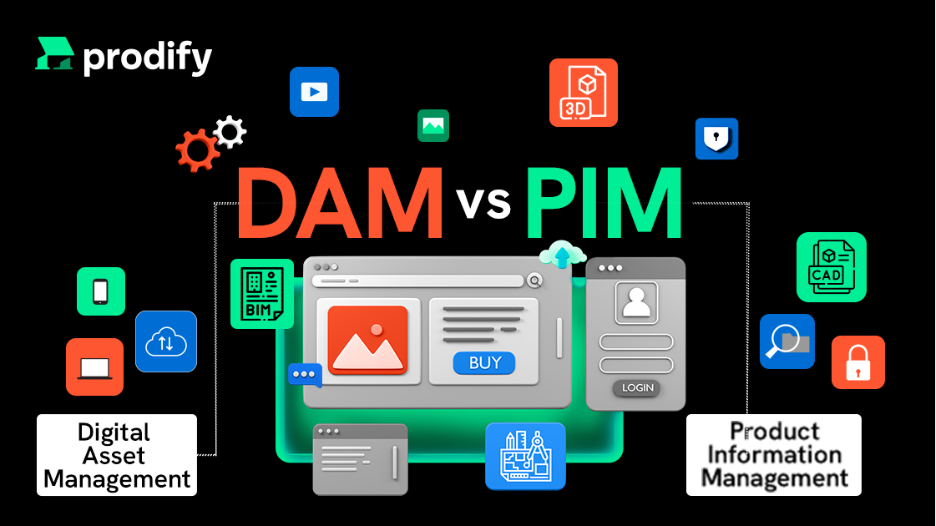
DAM helps you manage your content, while a PIM helps you manage your products. Let’s break them down one by one.
Digital Asset Management (DAM)
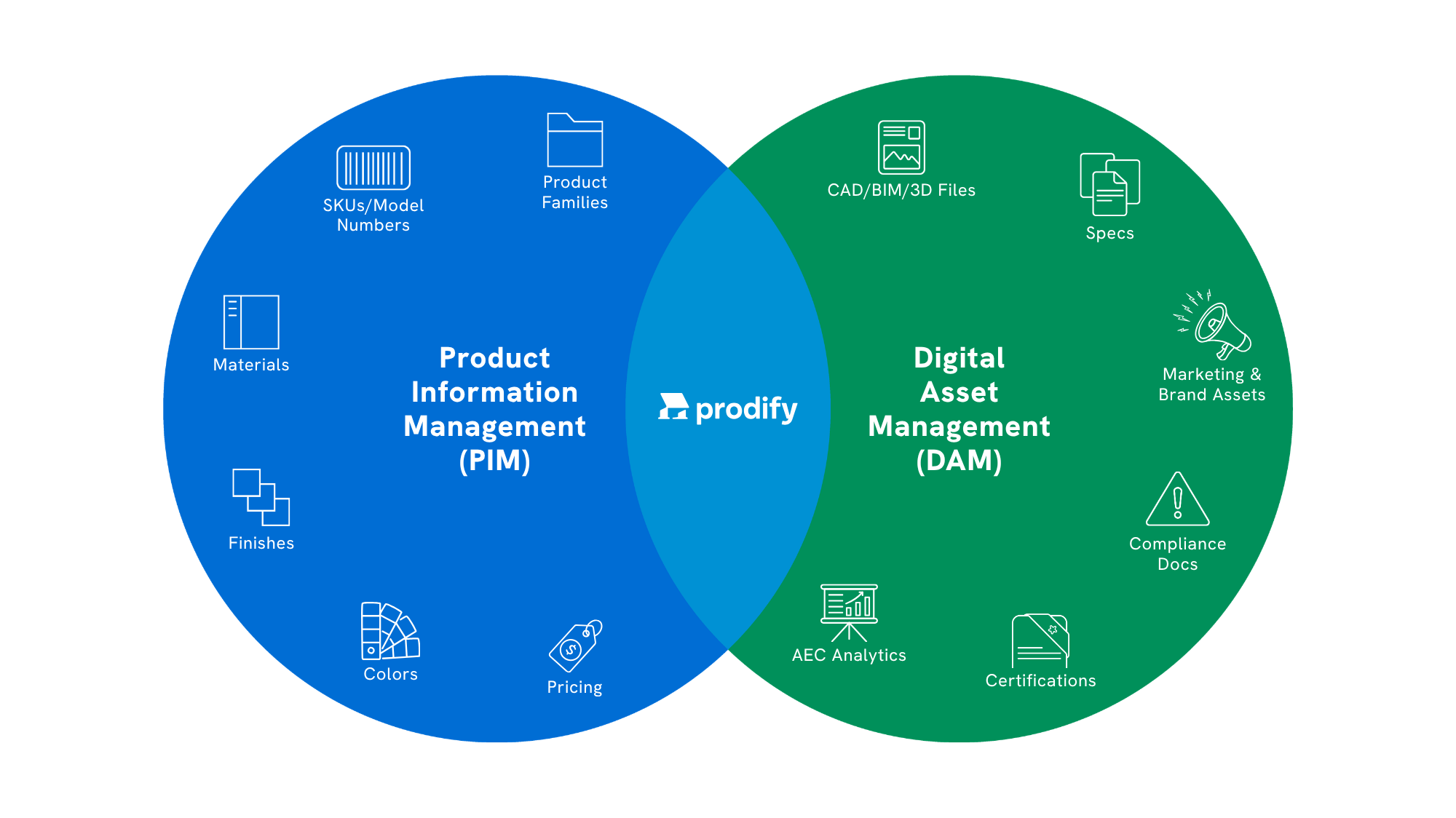
DAM system helps you store, organize, and distribute your digital assets, including:
- Images
- Videos
- Catalogs
- Brochures
- Design files (CAD/BIM/3D)
What it’s for: Making sure your team can quickly find and use the right assets.
Simple example: A sales rep needs a product brochure → they go to your DAM to access it.
Product Information Management (PIM)
PIM system manages your structured product data, including:
- Dimensions
- Materials
- Finishes
- SKUs/Model numbers
- Pricing
What it’s for: Centralizing your product information and keeping it consistent everywhere.
Simple example: Marketing updates a product spec → it updates across your website.
Why a DAM or PIM Alone Isn’t Enough
Many manufacturers start with DAM—and it makes sense. Organizing your assets is a big step forward. Your team can quickly find approved visuals, maintain brand consistency, and ensure everyone is using the latest versions of assets.
Others start with PIM (which is seeing growing adoption in North American manufacturing) and focus on centralizing and managing product data, so everything stays accurate and consistent across every channel.
But when used alone, each falls short.
With only DAM:
- Your assets are organized, but disconnected from the product data behind them
- Teams still rely on spreadsheets for product data
With only PIM:
- Your data is structured, but lacks the supporting visuals and assets
- Sales and marketing struggle to find and share the right content
In both cases, you end up juggling multiple systems and manually connecting the dots, leading to inconsistencies and a higher risk of outdated or incorrect information reaching prospects.
Why DAM + PIM Is the Real Solution
When DAM and PIM work together, your assets are directly tied to the right products. Everything lives in one connected system—making it easier to find, update, and share both product info and assets.
The result? Your team moves faster, your content stays consistent, and your product files are always ready to be discovered, shared, and specified.
Here are the top 3 benefits of DAM + PIM for manufacturers:
1. Keep everything consistent: By connecting your product data and assets, everything stays aligned across every channel. And when product changes happen, marketing can quickly see what’s impacted and update all related assets with confidence.
2. Move faster as a team: Marketing, sales, and product teams all work from a single source of truth, so there’s no more second-guessing or searching.
3. Deliver better product experiences: Give AEC pros accurate, up-to-date product information paired with high-quality, ready-to-use assets they can specify into their design plans.
Why Integration Matters: DAM + PIM in One Platform
There are plenty of standalone DAM and PIM solutions you can integrate, like Bynder (DAM) with Inriver (PIM), or MediaValet (DAM) and Akeneo (PIM).
But managing multiple systems—and the integrations between them—can quickly become complex. Sync issues, duplicate work, and ongoing maintenance can slow your team down.
So why deal with that complexity when there are all-in-one platforms that bring DAM and PIM together from the start?
Here are a few key advantages of an integrated DAM + PIM:
- One source of truth: Keep your product data and assets connected in a single system, so everything stays accurate and aligned.
- No integration headaches: Avoid the time, cost, and technical overhead of maintaining connections between multiple tools.
- Better collaboration: Marketing, sales, and product teams all work from the same platform, reducing back-and-forth and confusion.
- Quicker time to market: Launch campaigns and updates faster without waiting on multiple systems to sync.
Check out the top 13 DAM + PIM solutions in 2026→
Where Prodify Fits In
Your assets and your product data are meant to work together—and Prodify is built with that in mind. It brings DAM and PIM into a single platform designed specifically for manufacturers, so everything stays connected from the start.
Without that connection, inefficiencies start to creep in. Teams waste time switching between systems, inconsistencies slip through, and opportunities are missed.
Instead of juggling multiple systems, Prodify gives you one place to centralize your assets and product data, keep everything in sync, distribute content across all your channels, and track what’s driving engagement.
The result is a streamlined workflow, better alignment across teams, and more of your products getting specified.
Want to Try Prodify?
DAM and PIM aren’t competing solutions—they’re complementary. And when they’re unified, everything just makes sense.
Discover how Prodify connects DAM and PIM so you can work smarter, move faster, and make your products shine.