
Your Distributors Deserve Better Product Content. Here’s How DAM Gives It to Them
iD INTERIORS on Unsplash
Your products appear everywhere: on distributor sites, in reseller catalogs, on marketplaces, in specifiers' project binders. But not always the way you intended.
For building product manufacturers, that gap is expensive. A distributor still lists your 2019 spec sheet, with the old thickness, the old fire rating and a retired SKU. One reseller shows your current logo; another shows the version from three years ago. Your new 14-image product pack sits ready on your server while the dealer's listing runs on three photos pulled from an old email attachment. And every week, someone on your marketing team re-sends the same files to a partner who asked for them last month.
The cost shows up in places that are hard to trace: customer returns when the product doesn't match the listing, specifiers who move on from a thin product page, and marketing hours spent acting as a file server instead of growing the business.
The fix isn't sending files faster. It's giving every partner one place to get the right content, always current, without having to ask you for it. That's what a centralized asset hub does, and your distributors gain as much from it as your marketing team does.
3 Ways Your Distributors Benefit from a Centralized Asset Hub
1. They always have the current version
In most manufacturer–distributor relationships, the distributor's copy of your content is frozen the day they downloaded it. Your current spec sheet lists the new thickness, weight and fire rating; their 2019 copy still shows the old values and a SKU you retired. The customer orders from that listing, the product doesn't fit, and your brand takes the blame.
With a centralized hub like Prodify, you upload the updated asset once. Version history keeps the old file on record, and the new one refreshes across your owned and partner channels automatically. Every distributor shows the same, current product, which means fewer returns and distributors who keep reordering with confidence.
The same goes for brand assets. When every partner pulls your logo from one source, prospects stop seeing two versions of your brand on two different listings.
2. They get complete listings, not scraps
You have a full set of up-to-date product images, spec sheets and install guides. Your distributor's listing has three photos pulled from an old email attachment. A specifier lands on that thin page, assumes the information doesn't exist, and moves on. It's a lost deal you'll never hear about.
A centralized hub puts your complete product library within reach. In Prodify, every image, video, PDF and technical file is attached to the product it belongs to, so distributors find the whole package in one place. Built-in previews for DWG, SketchUp and 3D files let them confirm they have the right drawing without opening CAD software.
3. They stop waiting on you, and you stop being a file server
Partners email your team every time they need an asset. Your team re-sends it. Then a different distributor asks for the same file next week. Multiply that by every partner, product and launch, and your marketing team becomes a file server instead of growing the business.
A hub turns that into self-serve. In Prodify, you create share groups by region or partner type, such as "US West Distributors," and share content to the group once. Add a new rep and they instantly see everything shared with that group; remove someone who's left and their access is revoked across all content. You can also see who viewed, downloaded or hasn't yet opened what you shared.
The time savings add up quickly. Flooring manufacturer Maxxon now finds files 10x faster and saves 5 to 10 hours a week with Prodify.
Where DAM Fits In
A centralized asset hub runs on digital asset management (DAM): the system that stores, organizes, versions and shares every file your partners need. For building product manufacturers, that means product photos and renders, installation videos, spec sheets, brochures, and technical files like CAD drawings, BIM objects and 3D models.
DAM sits between the teams that create content and every channel that uses it. Marketing, product and sales teams add and update files in one place, and distributors, resellers, marketplaces, specifiers and your own website pull from that same source. Without it, the "source" is a mix of shared drives, inboxes and personal folders, which is how outdated spec sheets end up on distributor listings.
DAM works best alongside product information management (PIM), which holds your structured product data:
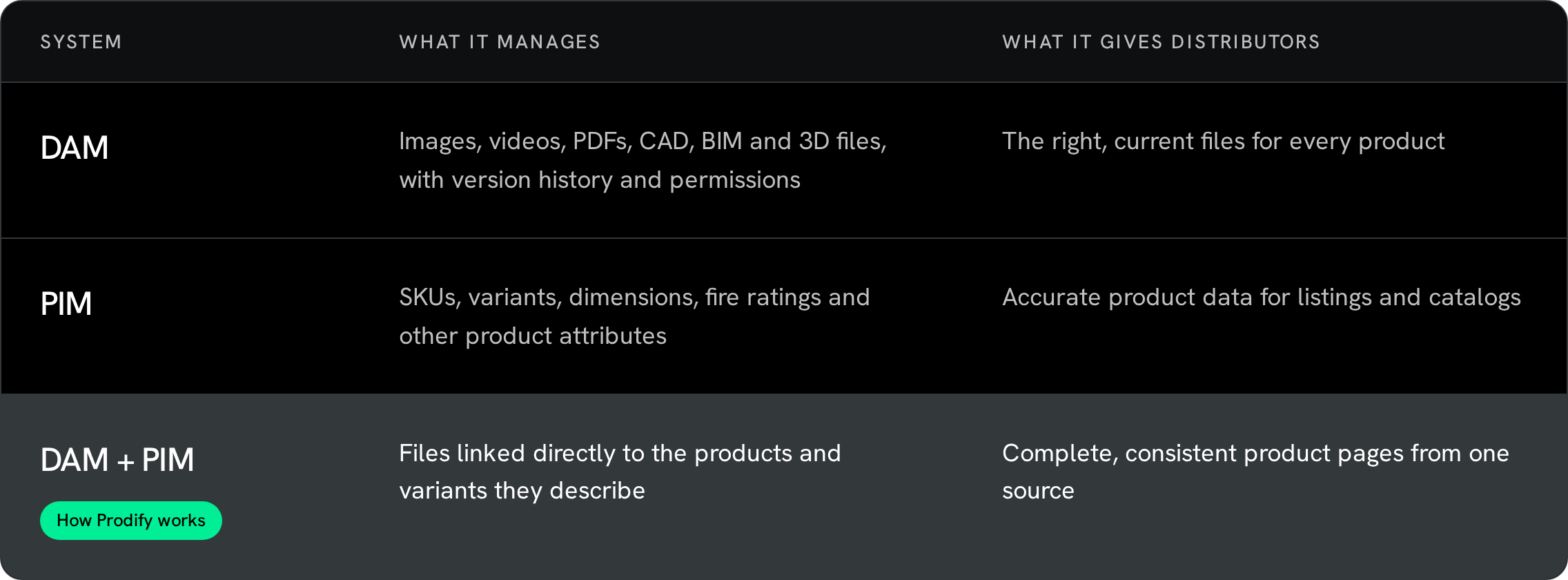
On its own, a DAM can tell a distributor where the latest image is, but not which SKU it belongs to. Pairing the two is what lets a single update flow out to every partner correctly. That's why Prodify combines DAM and PIM in one platform built for building products, rather than asking manufacturers to stitch two tools together.
What to Look For in a DAM
Not every DAM is built for the way building products are sold. If your distributors and specifiers mostly need spec sheets, CAD drawings, BIM objects and current product photos, choose a platform that handles technical files natively, not one that treats them as generic attachments.
Before you sign, ask yourself these questions:
- Can I preview a DWG or Revit file in the browser without extra software?
- If I update a spec sheet today, how does that change reach every distributor's listing?
- Can I add or remove a dealer's access in one step, and see what they downloaded?
Prodify was built specifically for building product manufacturers, so the answer to all three is yes. Whether you have 5 partners or 50, your product content stays accurate and up to date across all of them.
Book a demo to see how manufacturers manage their channels with Prodify.