
Why AI Can't Find Your Products (And How to Fix It)
Aalo Lens on Unsplash
Centralizing your product assets and data in a Digital Asset Management (DAM) and Product Information Management (PIM) isn't just good housekeeping. It's the foundation for one of the most important shifts happening in how AEC (Architecture, Engineering, and Construction) pros specify building products right now.
74% of AEC companies globally are already using AI in one or more phases of their building projects, and more and more specifiers are turning to AI to make their product research faster and more efficient. And even when they search on traditional platforms like Google, AI overviews now claim the top spot in results.
What this means is straightforward: your product content needs to be easy for AI to find and read, or your products won't get found. In this blog, we're covering:
- What Being AI Ready Means
- What AI Is Actually Looking For
- What an MCP Is & Why It Matters
- 5 Tips to Get AI Ready
- Why AI Ready & Spec Ready Are the Same Goal
What Being AI Ready Means
When a specifier asks an AI tool to recommend a glass partition system with a specific STC rating, LEED contribution, and profile depth, AI doesn't browse the internet the way a person does. It queries structured, accessible, machine-readable information, and it does it fast. If your product data lives in a PDF brochure, a scattered SharePoint folder, or an outdated page on your website, it can't read it properly.
This is the part most manufacturers miss. It's not that AI is ignoring your products—it's that AI can't find or understand them. Being AI Ready means your product assets and data are easy for AI tools to recommend when specifiers come looking. If your content is structured, clearly labeled, and detailed enough for AI to match it to real project needs, your products show up, and your chances of winning the spec skyrockets.
What AI Is Actually Looking For
Here's what AI looks for when searching for building products to surface in its responses:
- Structured attribute data: Dimensions, weights, fire ratings, acoustic ratings, thermal performance, finish options, etc. All this info needs to live in clearly labeled fields, not buried in CAD/BIM files, specifications, or paragraphs of marketing copy. Without it, AI has to guess, and it often guesses wrong or leaves you out altogether.
- Consistent naming conventions: If the same product or design file is called three different things across your catalog, your website, and your CADdetails listing, AI might get confused and list them as three different options instead of one. Consistency isn't just tidy, it's how AI connects the dots and recognizes what you actually make. Learn more about naming best practices here.
- Performance and application descriptions: AI needs to understand what your product does and where it's used, not just what it looks like. "Aluminum storefront system suitable for curtainwall applications in high-wind zones" gives AI something to work with. "Sleek, modern profiles available in a range of finishes" does not.
- Current, accessible design files: AI tools increasingly pull actual product files (CAD drawings, BIM models, 3D models, specifications) alongside product information. Files that are outdated, incorrectly formatted, or hard to access get skipped in favor of ones that aren't.
This is exactly why an integrated DAM and PIM platform matters so much. When your assets and your product data live together in one organized system, AI has everything it needs in one place: the files it can surface to a specifier, and the structured data it needs to know when to surface them. That combination—organized data alongside accessible assets—is what makes your products genuinely findable in an AI-assisted search.

What an MCP Is & Why It Matters
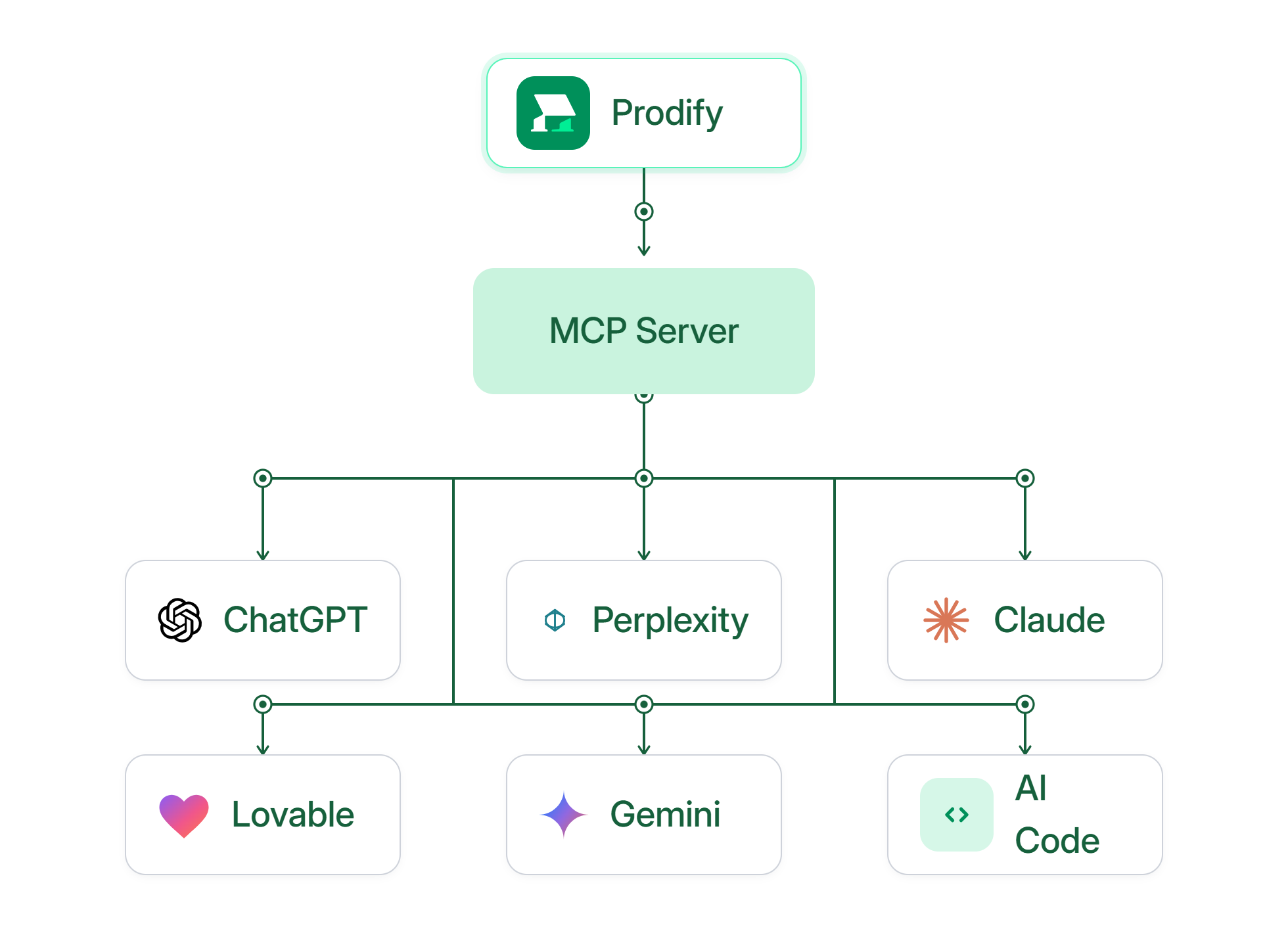
So, how does AI actually access that data from your DAM and PIM? There are two ways.
The first is distribution: pushing your PIM and DAM content out to public channels like CADdetails and your website, where AI can surface it in response to searches and prompts.
The second is MCP (Model Context Protocol). Think of it as the USB-C of the AI world: a universal connector that lets any compliant AI model plug directly into your product data, wherever it lives.
Prodify's MCP makes your product content directly accessible to the AI tools specifiers are already using, like Claude, ChatGPT, Perplexity, and Gemini. It creates a common framework that lets AI systems access and understand your assets and data, so it can surface the right product to the right specifier at the right moment.
5 Tips to Get AI Ready
Once your products are organized in a DAM and PIM, here's how to make sure AI can find them:
- Attach assets to your products: Tie the products in your PIM to the right assets in your DAM so everything is properly connected.
- Check every attribute field: Go through your priority products and make sure every field is populated. No blanks, no "N/A." If a field is empty, AI can't use it.
- Set up product relationships: If products come in a family—a base product with multiple configurations, sizes, or finishes—those relationships should be explicitly defined in your PIM.
- Read your product descriptions out loud: Ask yourself: does this describe what the product does, or just what it looks like? If it's mostly aesthetic, rewrite it for performance and application.
- Audit your naming conventions: Make sure your products are named consistently everywhere they appear online.
Why AI Ready & Spec Ready Are the Same Goal
To get AI Ready, you need the same structured foundation you've already been building if you've been following the Spec Ready framework.
Spec Ready asks: can a specifier find my product, trust my files, and write me into a project?
AI Ready asks: can an AI tool understand my product well enough to recommend it?
The answer to both questions is the same: structured, complete, accessible product data, hosted in a DAM & PIM system that keeps it current and pushes it to the right places.
Learn more about how to get Spec Ready here →
Get AI Ready with Prodify
Scattered files and unstructured data aren't just inconvenient—in the context of AI discoverability, they're invisible. And as more specifiers turn to AI to find and evaluate products, invisibility is a problem you can't afford.
Visibility starts with your assets and data organized, complete, and connected in Prodify. Once they are, our MCP takes care of the rest, making your product content queryable by any compliant AI tool a specifier might use, without any extra work on your end.
Don't be the product that gets passed over because AI couldn't find you. Book a demo today to try Prodify→