
The 5 Pillars of Spec Readiness: A Q&A with Prodify’s VP of AEC & AI Enablement
Axel Pereira on Unsplash
"What exactly do I need to get specified?" It's one of the most common questions manufacturers ask, and the answer isn’t as straightforward as you’d think.
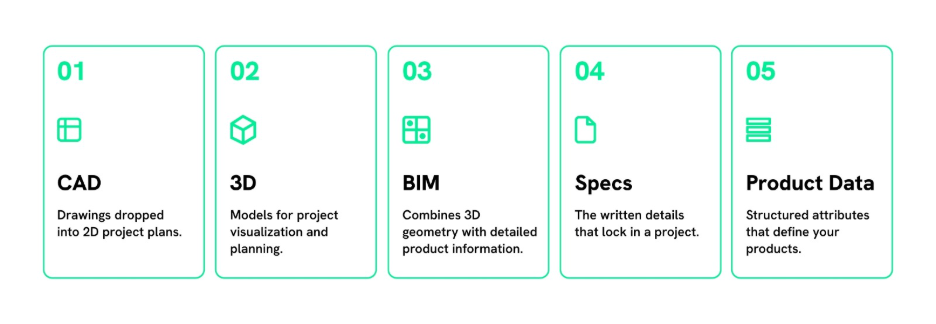
To break it down, we spoke with Steve Trotter, VP of AEC & AI Enablement at Prodify, who shared the 5 essential pillars of product content every manufacturer needs to consider before being fully spec ready:
- CAD
- BIM
- 3D
- Specs
- Product Data
To learn more about each pillar and how they all work together, let’s jump straight into our conversation with Steve.

Q: Can you walk us through each of the 5 pillars and explain why they matter?
Absolutely, let’s go over them one at a time.
1. CAD
For many projects, CAD is the first touchpoint with a product. Specifiers use 2D drawings to quickly explore options, test layouts, and see how products fit into their designs. When your CAD files are easy to access and work with, it becomes much easier to include your products early in the project, which is exactly where you want to be.
2. BIM
BIM takes things a step further by combining 3D geometry with valuable product data, giving AEC pros the information they need to design, coordinate, and document a project. A well-built BIM family doesn't just show what a product looks like—it provides the technical details and performance data needed to confidently incorporate that product into a building model.
3. 3D Models
High-quality 3D models help project teams understand how products will look and fit within a space before anything is built. From client presentations to design reviews, 3D models help bring projects to life and support better decision-making along the way.
4. Specifications
A specification is a document that outlines exactly which product should be used and how it needs to perform on a project. They play a huge role in moving your product from being considered to being formally documented as part of the project requirements, which significantly reduces your risk of being substituted down the road.
5. Product Data
Product data is the foundation that ties everything together. It includes the essential details AEC pros rely on, things like dimensions, materials, finishes, certifications, and performance data. When that information is incomplete, outdated, or hard to find, it’s a major roadblock. But when your data is accurate, up to date, and accessible, it becomes easier to lock your products into a project and keep them there.
Q: Why is it important to have all 5 pillars?
That's a great question because many manufacturers invest heavily in CAD or BIM and assume they've checked the box. The reality is that AEC pros all work differently—and they rely on different types of content throughout the life of a project.
An architect might discover your product through structured product data, evaluate it using BIM content, add CAD drawings to their designs, review 3D models with stakeholders, and ultimately lock it into the project with written specifications. Every pillar serves a purpose and helps move your product one step closer to being specified.
The moment a specifier can't find what they need in the format they need it, they move on. All five pillars exist because different people on the same design team, or at different stages of design are looking for different things—often all at the same time. Cover them all, and your product stays in the project. Miss one, and you're depending on someone else to close the gap.
Q: Let’s talk more about product data. Why is it different than the other 4 pillars?
The other four pillars are delivery formats. Think of them as the four ways your product reaches specifiers depending on how they work and what phase of the design process they're in.
But look closely at any of those files, and you'll find the same underlying information: dimensions, materials, finishes, performance characteristics. A BIM family embeds it in a model. A spec writes it into its sections. A 3D model expresses it visually or in its metadata. The difference is that inside a file, that information is locked in—it travels with the asset, goes stale with the asset, and only updates when the asset is reissued.
That's why product data needs its own Product Information Management (PIM) system—not because it's separate from your digital assets, but because it's the source that keeps all of them accurate and in sync.
There's another reason product data has become so important: AI. AEC pros are increasingly turning to AI to find and evaluate products, but it can only surface what it can access and understand, so the quality of your product data directly impacts your visibility in AI-generated outputs.
When your product data is structured, accurate, and consistently maintained, AI can correctly identify your products, match them to project requirements, and surface them in answers. But when product information is incomplete, inconsistent, or difficult to interpret, your products become harder to find and less likely to be recommended—even if you have excellent CAD, BIM, 3D, and specifications.
Q: How do I know which of the 5 pillars I'm missing—and where to start?
Start with an honest audit. Not just "do we have a BIM file?" but "is it accurate, is it current, and would an architect actually be able to use it?" Prodify makes this straightforward. When your products are in the platform, you get a clear view of what you have—and what’s missing.
If you're not sure where to start, the answer is almost always product data first. Without accurate, structured product data in place, creating or updating your CAD, BIM, 3D, and specifications becomes much harder to manage and keep in sync.
Q: If I need help creating or updating CAD, BIM, and 3D assets for my products, what are my options?
Many manufacturers know they need CAD, BIM, and 3D content, but don't have the internal resources or expertise to create and maintain it. That's where we can help. Our team offers tailored design services to create, update, and optimize your design files so they meet industry standards and align with how AEC pros actually work.
Whether you're starting from scratch, modernizing legacy files, or updating your asset library, we're here to help.
Learn more about our design services→
Q: What about specifications? How can I get help with those?
If specifications are the missing piece of your spec-readiness strategy, we have a solution for that, too. Spec Builder Pro helps manufacturers quickly generate AI-powered outline specifications using their existing product content. It's a fast, scalable way to create and manage specs in the format AEC pros expect, helping you fill content gaps in minutes instead of weeks.
Learn more about our Spec Builder Pro→
Q: Once I have all 5 pillars, how do I actually reach AEC pros?
Having the content is half the equation. The other half is making sure it's somewhere AEC pros actually go to find it.
In practice, that means two places: your own website, and the platforms AEC pros already use as part of their workflow, like CADdetails. On both, the same rules apply. Your files need to be in formats AEC pros can use without friction, backed by accurate product data, and complete enough across all five pillars that a specifier can move from discovery to decision without having to track down missing pieces.
Wrapping Up
Getting specified depends on more than a single file or data point. It takes the right combination of CAD, BIM, 3D assets, specifications, and product data to give AEC pros the confidence to select your products.
When all 5 pillars work together, you’re doing more than providing content—you’re creating a smoother, more connected experience that helps keep your products in the project from concept through construction. Miss one piece, and you risk creating friction in the design process. And when AEC teams can’t quickly find what they need, they’re more likely to move on to a product that makes their job easier.
Prodify brings all 5 pillars together on one platform—making your products easier to create, manage, share, and specify. Book a demo today→